

OVERVIEW
What is an Oncology Nurse?
As cancer continues to impact millions worldwide, oncology nurses provide the specialized nursing care and support that patients rely on. They administer chemotherapy, explain treatment plans, and manage symptoms while creating an environment where patients feel seen, heard, and respected.
Whether you’re already a registered nurse looking to advance your nursing career or just exploring the possibility of becoming a nurse, the oncology specialty offers a meaningful way to make a difference in healthcare. Keep reading to discover what oncology nurses do and learn how this field combines advanced patient care with the opportunity to support patients during one of the most challenging experiences of their lives.

RESPONSIBILITIES
What Does an Oncology Nurse Do?
Oncology nursing involves a range of specialized responsibilities focused on guiding cancer patients through diagnosis, treatment, and recovery. Although specific patient care tasks may vary by setting, most oncology nurses perform the following duties:
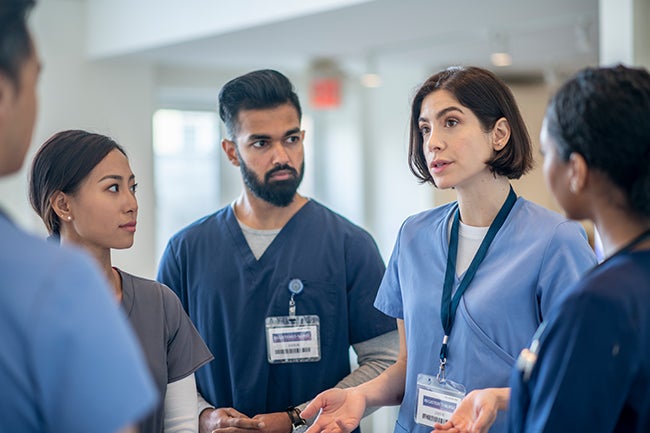
- Administering chemotherapy and other treatments. After oncologists determine the treatment plan, oncology nurses initiate treatments, adjust infusion rates, and monitor patients for adverse reactions.
- Managing IVs and central lines. Oncology nurses ensure that IVs, ports, and central lines are functioning correctly.
- Monitoring patients’ status. Nurses consistently track vital signs, test results, and pain levels to guide clinical decision-making and reduce discomfort.
- Managing symptoms and side effects. By combining medication management with compassionate support, nurses help patients cope with pain, nausea, fatigue, and other symptoms.
- Maintaining accurate documentation. As treatment progresses, oncology nurses record details that provide the care team with a clear and reliable picture of the patient's status.
- Offering empathy and encouragement. Oncology nurses provide the reassurance, empowerment, and emotional steadiness that helps patients feel more confident and less alone.
- Educating patients and their families. Oncology nurses answer questions and break down complex medical information into clear, actionable steps.
- Coordinating with the healthcare team. Nurses provide updates and facilitate clear communication to ensure cancer care is organized and consistent.
- Providing follow-up care. Because complications can arise after treatment, oncology nurses regularly check in with patients to see how they’re doing and address any issues that arise.
EDUCATION & BEST DEGREES
How Do I Become an Oncology Nurse?
Becoming an oncology nurse requires formal education, clinical experience, and focused training. While this career path begins like any other registered nursing career, oncology nurses must complete additional steps to build the skills and knowledge involved in this complex specialty.
Earn an Accredited Nursing Degree
To become an oncology nurse, you must first become a registered nurse (RN). The minimum education required for RNs is an associate degree. However, a Bachelor of Science in Nursing (BSN) provides more comprehensive clinical training and may be required for oncology nursing roles. Once you’ve completed your nursing degree, the next step is to pass the National Council Licensure Examination (NCLEX-RN) to obtain your license. RN licensure requirements differ by state, so be sure to check the guidelines for the state where you plan to practice.
Consider an RN-to-BSN Pathway
Employers increasingly prefer nurses with a BSN, especially for specialized or leadership roles. If you’re already a registered nurse, an RN-to-BSN degree can strengthen your clinical skills and help you qualify for more advanced opportunities. WGU’s RN-to-BSN program includes courses in comprehensive health assessment, intrapersonal leadership, population health, healthcare policy and economics, and other essential subjects. It can be completed in as little as one year, and many WGU students are able to maintain full-time employment while completing the program.
Strengthen Your Credentials with OCN Certification
The Oncology Certified Nurse (OCN) credential demonstrates your expertise in cancer care and strengthens your professional credibility, making you a stronger candidate for oncology-focused roles. To qualify for this certification, you must:
- Hold an active RN license.
- Have at least two years of RN experience.
- Complete 2,000 hours of adult oncology practice within four years prior to application.
- Complete 10 continuing education hours in oncology within three years prior to application.
Once you’ve met the eligibility criteria, you’ll need to pass the OCN exam to earn the certification. This test assesses your knowledge of oncology-specific concepts, patient care standards, and treatment practices.
Pursuing Continuing Education
While a BSN lays the foundation for a meaningful career in oncology nursing, some nurses choose to pursue graduate-level degrees to further expand their expertise. A master’s degree in nursing can unlock a world of opportunities in healthcare, from leadership roles to advanced positions in nursing education, clinical leadership, and informatics.
Best Degrees for an Oncology Nurse
 Health & Nursing
Nursing (Prelicensure) – B.S.
A one-of-a-kind nursing program that prepares you to be an RN and a...
A one-of-a-kind nursing program that prepares you to be an RN and a baccalaureate-prepared nurse:
- Locations: Due to in-person clinical requirements, students must be full time residents of Arkansas, Florida, Idaho, Indiana, Iowa, Kansas, Kentucky, Michigan, Minnesota, Mississippi, Missouri, Nebraska, Nevada, New Mexico, Ohio, Oklahoma, South Carolina, South Dakota, Tennessee, Texas, Utah, Virginia, West Virginia, or Wisconsin to enroll in this program. The coursework in this program is offered online, but there are in-person requirements.
- Tuition: $8,755 per 6-month term for the first 4 terms of pre-nursing coursework and $8,755 per 6-month term for the remaining 4 terms of clinical nursing coursework.
- Time: This program has a set pace and an expected completion time of 4 years. Certain coursework may be accelerated to finish faster.
- WGU offers the prelicensure program in areas where we have partnerships with healthcare employers to provide practice sites and clinical coaches to help teach you and inspire you on your path to becoming a nurse.
- If you don't live in one of our prelicensure states or don't qualify to apply, consider getting our Bachelor's in Health and Human Services instead. This degree allows you to work inside the healthcare industry, while also working directly with patients who need help.
Skills for your résumé that you will learn in this program:
- Community Health
- Women's and Children's Nursing
- Pathology
- Physiology
- Research
Health & Nursing
Nursing (RN-to-BSN Online) – B.S.
An online BSN degree program for registered nurses (RNs) seeking the added...
An online BSN degree program for registered nurses (RNs) seeking the added theoretical depth, employability, and respect that a bachelor's degree brings:
- Time: The program is designed to be completed in 1 year.
- Tuition: $5,325 per 6-month term.
- Courses: 23 total courses in this program.
- Transfers: Students can transfer up to 90 credits.
Skills for your résumé that you will learn in this program:
- Healthcare Policy and Economics
- Information Technology in Nursing Practice
- Anatomy and Physiology
- Applied Healthcare Statistics
If you don't currently have an RN and don't qualify for your nursing prelicensure program, consider getting our Bachelor's in Health and Human Services instead. This degree allows you to work inside the healthcare industry in a unique way.
Health & Nursing
Nursing – Leadership & Management (RN-to-MSN) – M.S.
This program for RNs includes a BSN component and is a substantial leap...
This program for RNs includes a BSN component and is a substantial leap toward becoming a nurse leader.
- Time: 62% of RN-to-MSN grads finish within 37 months.
- Tuition: $5325 per 6-month term during undergraduate portion and $5050 per 6-month term during graduate portion.
- Courses: 32 total courses in this program.
Skills for your résumé you will learn in this program:
- Quality Outcomes in a Culture of Value-Based Nursing Care
- Nursing Leadership and Management
- Advanced Pathopharmacological Foundations
- Informatics for Transforming Nursing Care
If you're driven to lead, this online nursing degree will provide you everything needed to make that career a reality. This program is ideal for current RNs who are interested in earning both their BSN and MSN in an accelerated program.
Compare degrees
This program is not the only degree WGU offers designed to create leaders in the field of healthcare. Compare our health leadership degrees.
Health & Nursing
Nursing – Leadership & Management (BSN-to-MSN) – M.S.
For registered nurses with a bachelor's degree who are ready for...
For registered nurses with a bachelor's degree who are ready for additional career opportunities.
- Time: 61% of grads finish within 23 months
- Tuition: $5050 per 6-month term
- Courses: 15 total courses in this program
This program is ideal for current RNs who have a BSN and are ready for the next step in their education.
Skills for your résumé you will learn in this program:
- Quality Outcomes in a Culture of Value-Based Nursing Care
- Nursing Leadership and Management
- Advanced Pathopharmacological Foundations
- Informatics for Transforming Nursing Care
Compare degrees
This program is not the only degree WGU offers designed to create leaders in the field of healthcare. Compare our health leadership degrees.
Health & Nursing
Nursing Leadership and Management – Post-Master's Certificate
A certificate for registered nurses with a master's degree in nursing who...
A certificate for registered nurses with a master's degree in nursing who are ready for greater responsibility in a leadership and management role.
- Time: Students typically finish this program in 12 months.
- Tuition: $5050 per 6-month term. The cost to sit for the NAHQ Certified Professional in Healthcare Quality (CPHQ) exam is included in tuition.
- Courses: 8 total courses in this program.
Skills for your résumé that you will learn in this program:
- Strategic Planning
- Resource Management
- Business Case Analysis
- Evaluating Healthcare Improvements
Health & Nursing
Health and Human Services – B.S.
An online health degree program for students who are committed to making a...
An online health degree program for students who are committed to making a difference for patients in a variety of ways.
- Time: 63% of students finish this program in 24 months
- Tuition: $4425 per 6-month term
- Courses: 35 total courses in this program
Skills for your résumé that you will learn in this program:
- Epidemiology
- Community and Public Health
- Cultural Awareness
- Pathophysiology
- Healthcare Values and Ethics
- Substance Abuse Support
This degree allows you to work inside the healthcare industry, while also directly working with patients who need help.
Health & Nursing
Nursing – Nursing Informatics (RN-to-MSN) – M.S.
A nursing program that empowers data-driven nurses with a BSN and MSN...
A nursing program that empowers data-driven nurses with a BSN and MSN component, allowing them to go from RN to MSN.
- Time: 63% of RN-to-MSN grads finish within 36 months.
- Tuition: $5325 per 6-month term during undergraduate portion and $5050 per 6-month term during graduate portion.
- Courses: 31 total courses in this program.
This program is ideal for currently licensed RNs who are looking to earn a bachelor's degree and a master's degree at an accelerated pace.
Skills for your résumé that you will learn in this program:
- Informatics System Analysis and Design
- Data Science and Analytics
- Advanced Pathopharmacological Foundations
- Leadership and Management
The trajectory of data and informatics in healthcare will continually open opportunities for registered nurses who take this path.
Health & Nursing
Psychiatric Mental Health Nurse Practitioner (BSN-to-MSN) – M.S. Nursing
This program for BSNs who have an active, unencumbered RN license prepares...
This program for BSNs who have an active, unencumbered RN license prepares you to become a board-certified Mental Health Nurse Practitioner.
- Locations: Due to the clinical requirements of this degree program, the PMHNP program at WGU is currently NOT open to students who have a permanent residence in the following states: California, District of Columbia, Louisiana, New York, North Dakota, and Washington.
- Time: It takes 2.5 years to complete the coursework and clinical components of this degree program.
- Tuition and fees: $6955 per six-month term.
- Courses: 17 total courses in this program.
This program is for current RNs who have earned their BSN and are ready to move forward in their career. This MSN program prepares students to become licensed as a Psychiatric Mental Health Nurse Practitioner in select states.
Skills for your résumé that you will learn in this program:
- Advanced Pathophysiology
- Assessment and Diagnostics
- Behavioral health
- Advanced Pharmacology
Students must have a permanent and active license from a state that is not listed above, must complete the internships in that state, and intend to obtain initial APRN licensure in that state. See more state-specific information related to nursing licensure. Compact licenses must be endorsed by your state of residence. More about compact licenses.
Health & Nursing
Family Nurse Practitioner (BSN-to-MSN) – M.S. Nursing
This program for BSNs who have an active, unencumbered RN license prepares...
This program for BSNs who have an active, unencumbered RN license prepares you to become a board-certified Family Nurse Practitioner.
- Locations: Due to the clinical requirements of this degree program, the FNP is currently NOT available to students who have a permanent residence in the following states: California, District of Columbia, Louisiana, New York, North Dakota, Washington.
- Time: It takes 2.5 years to complete the coursework and clinical components of this degree program.
- Tuition: $6955 per six-month term.
- Courses: 16 total courses in this program.
Skills for your résumé that you will learn in this program:
- Leadership and Management
- Adult Primary Care
- Pediatric Primary Care
- Special Populations Primary Care
- Advanced Health Assessment
Students must have a permanent and active license from a state that is not listed above, must complete the internships in that state, and intend to obtain initial APRN licensure in that state. See more state-specific information related to nursing licensure. Compact licenses must be endorsed by your state of residence. More about compact licenses.

How Much Does an Oncology Nurse Make?
$91,094
According to ZipRecruiter, the national average annual salary for oncology nurses is $91,094. Top earners can make more than $164,000 a year. Oncology nurse salaries are influenced by factors such as the nurse’s education level, years of experience, geographic location, and work setting. Professional certifications can also boost an oncology nurse’s earning potential, as many employers acknowledge the advanced skills that certified nurses bring to their practice.
What Is the Projected Job Growth?
5%
According to the U.S. Bureau of Labor Statistics (BLS), the employment of registered nurses, including oncology nurses, is expected to grow by 5% from 2024 to 2034. Rising cancer rates, an aging population, and expanded access to advanced cancer treatments are driving the need for skilled oncology nurses who can deliver safe, specialized care.
SKILLS
What Skills Does an Oncology Nurse Need?
Oncology nurses need a combination of clinical, technical, and interpersonal abilities to care for patients undergoing cancer treatment. Some of the most essential skills for oncology nurses include:
- Clinical assessment. Nurses must carefully monitor patients and recognize changes in their condition.
- Acute care skills. When complications arise, nurses must be prepared to provide immediate interventions.
- Communication. Clear, effective communication is needed to explain treatments and procedures, collaborate with providers, and ensure patients know what to expect.
- Clinical judgment. Evidence-based decision-making and strong clinical intuition allow nurses to respond confidently to changing patient needs.
- Emotional intelligence. Oncology nurses care for people during some of the most challenging moments of their lives. Recognizing their emotional needs and responding with empathy is essential for building trust.
- Technical proficiency. Precise operation of IV pumps, ports, central lines, and other equipment is crucial for the safe delivery of chemotherapy and other treatments.
- Attention to detail. Oncology nurses must follow established protocols and ensure accurate medication administration and documentation.
Frequently Asked Questions About Becoming an Oncology Nurse
Where Do Oncology Nurses Work?
Oncology nurses can work in a variety of clinical environments, including hospitals, outpatient centers, clinics, and hospice facilities. Some oncology nurses provide care in home health care settings. Besides clinical work, they may also engage in research and academic activities, assisting with clinical trials and the development of new therapeutic protocols.
How Long Does It Take to Become an Oncology Nurse?
The amount of time it takes to become an oncology nurse depends on your educational and professional background, as well as the type of nursing education you pursue. For many nurses, the process takes two to four years. However, accelerated and competency-based programs can shorten the amount of time it takes to earn the necessary credentials.
What Training Do Nurses Need Before Working with Cancer Patients?
Along with foundational RN education, oncology nurses undergo specialized training in cancer therapeutics, symptom management, and psychosocial care. They learn about chemotherapy safety, infusion practices, and how to recognize adverse treatment reactions.
Why Become an Oncology Nurse?
Oncology nursing offers job stability, competitive pay, and ample opportunities for career advancement. The role offers the chance to support patients during an incredibly difficult time in their lives, making the work deeply purposeful.
Elevate Your Healthcare Career with an Accredited Degree from WGU
Whether you’re years into a nursing career or just starting, WGU has a nursing degree program to meet your needs. WGU’s nursing programs are competency-based, meaning you progress by demonstrating mastery of the material, rather than spending a fixed amount of time in class. With online courses available 24/7, flexible scheduling, and start dates on the first of every month, WGU lets you advance your education on your terms. Apply today to get started.
Our Online University Degree Programs Start on the First of Every Month, All Year Long
No need to wait for spring or fall semester. It's back-to-school time at WGU year-round. Get started by talking to an Enrollment Counselor today, and you'll be on your way to realizing your dream of a bachelor's or master's degree—sooner than you might think!
Next Start Date
{{startdate}}
Interested in Becoming an Oncology Nurse?
Learn more about degree programs that can prepare you for this meaningful career.


