
Building a Workforce to Save Rural Health
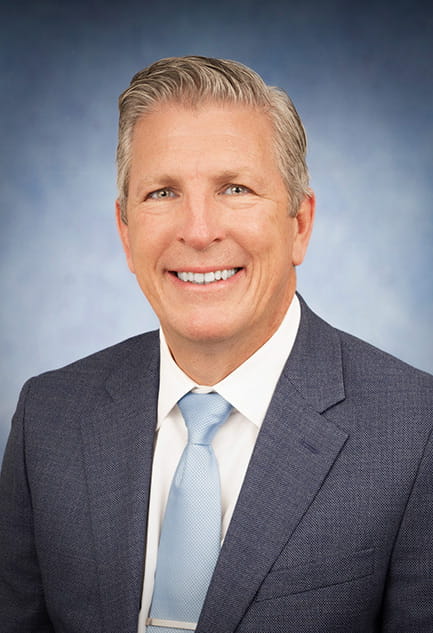
Around our family dinner table, education was always at the center of the conversation. My father, a teacher and principal, would recount a Friday night football game, a student struggling in class or a young student discovering confidence for the first time. My mother shared the quiet, life-changing conversations she had as a guidance counselor, helping students see a future they could not yet imagine. And though he died the year before I was born, my mother would often tell stories of my grandfather, who was a college president, and his work guiding a university through moments of change.
Later, I added my own stories from the classroom as a teacher and wrestling coach before eventually carrying those lessons with me into healthcare. Those conversations did not just shape my career. They shaped how I see people, equity and responsibility. Education has always been part of my DNA. That is why I am deeply grateful to join Western Governors University as senior vice president and executive dean of the Leavitt School of Health.
Education was the rock from which my worldview was formed but it was carved and refined during my healthcare career in the rural Central Valley of California, where the pavement often gives way to gravel and the nearest safety net clinic for the uninsured, where I worked, was a two-hour bus ride for many in a county of over 8,000 square miles. I was on the front lines of the healthcare provider shortage at Kern Medical Center and Kaweah Health, the region’s primary safety net hospital systems.
Serving a largely rural, agricultural population, we were often the only place people could turn. When clinics could not hire enough primary care providers, my neighbors had little choice but to rely on the emergency room for routine care. Preventable conditions worsened. Chronic disease went unmanaged. I learned quickly that shortages carry a real and lasting human cost.
For many, this is an abstract policy debate. For me, it was the daily reality for teachers, farmworkers and families across California’s Central Valley, and millions of people like them across the nation. This is not theoretical. It is life.

A System Under Strain
The data confirms what rural communities have known for years.
Since 2005, 195 rural hospitals have closed or stopped offering inpatient services. Nearly 200 rural counties now have zero primary care physicians. Nonmetro areas face a projected physician supply gap of more than 30% by the late 2030s.
This crisis extends beyond rural borders. The U.S. healthcare system faces a projected shortage of up to 450,000 nurses by 2025-2030. To close the workforce gap and keep pace with retirements, the system must fill approximately 193,000 nursing openings every year .
I spent years on the operational side of this equation, trying to recruit clinicians, doctors and nurses into communities that desperately needed them. The math never worked. Traditional education pathways alone were not built to solve a shortage of this magnitude.
That reality is why I'm here at WGU.
Quality at Scale
At the Leavitt School of Health, scale is why we exist.
The school was designed for this moment. Our competency-based education model demands mastery. Students do not advance because time has passed. They advance because they can prove what they know.
The outcomes matter.
Employers consistently tell us our graduates are prepared for the job. They meet or exceed expectations. They would hire another WGU graduate without hesitation.
This is not speed at the expense of standards. It is rigor delivered differently.
A Workforce Engine
Today, WGU operates at a scale few institutions can match. Since its founding, more than 116,000 health graduates have entered the workforce, with more than 27,000 students currently preparing to do the same. In the 2022-23 academic year, WGU conferred 5.4% of all U.S. bachelor’s and master’s nursing degrees in fiscal year 2025 alone, we awarded to help remove financial barriers for those answering the call to care.
But our work cannot stop at degree completion.
We are expanding prelicensure nursing programs to build the pipeline from the ground up. We are training students in value-based care, population health, and team-based delivery models because that is where health care is going, whether the system is ready or not.
Most importantly, we bring education to the student, not the other way around. When learners can stay rooted in their communities, they are far more likely to serve those communities long term.
A Path Forward
I have always cherished those family dinners with my mother and father, but I never imagined they were quietly preparing me to one day help lead a university transforming the healthcare workforce. They always believed education could change the world. At the Leavitt School of Health at WGU, I now can see that belief realized at scale by preparing well-trained, practice-ready professionals to serve the communities, including places like Tulare County, that need them most.


