
A WGU Grad’s Commitment to Service in Rural Maryland
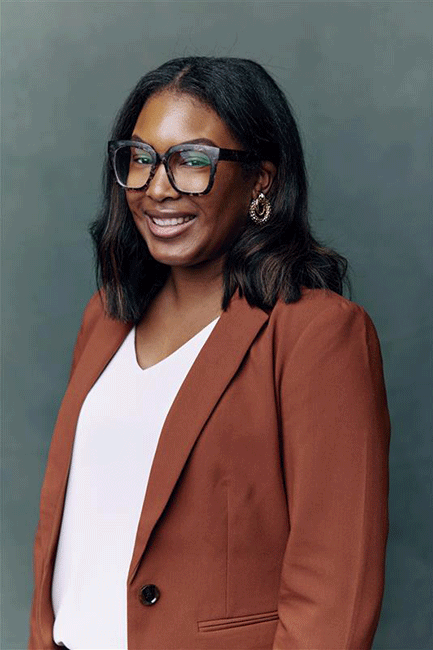
In rural Maryland, access to healthcare can mean a long drive, and emergency response often depends on volunteers. In that environment, service is a shared responsibility. For WGU graduate Jonathan Dayton, that responsibility shows up in more ways than one.
Dayton, who earned a master’s in management and leadership from WGU, serves as a volunteer firefighter and EMT across three firehouses while also working in community relations for Maryland Wellness, focusing on expanding access to behavioral health services. His work spans emergency response, public health and policy, but it all traces back to a simple idea – show up when your community needs you. For Dayton, that mindset started early.
“My father is the fire chief of Potomac Fire Company No. 2, so I essentially grew up in the firehouse,” he said. “When I became old enough to volunteer, it felt like a natural step.”

Answering the Call: Service Across Roles
Today, Dayton’s roles are split across multiple departments. At Baltimore Pike Volunteer Fire Company No. 4, he responds to calls as a firefighter and EMT. At Potomac Fire Company No. 2, where he first started, his focus has shifted toward leadership, serving on the board of directors, managing grants and leading communications. He also serves as department president for the Allegany County Sheriff’s Office Fire Police.
Balancing those responsibilities with a full-time career takes discipline, and for Dayton, it’s definitely a juggling act.
“I rely on simple tools like a running to-do list and shared documents to keep track of everything. It’s not always perfect, but it works,” he explained.
Even with all his responsibilities, what keeps him committed is perspective.
“If something were happening to my family, I would want someone to show up who is compassionate and ready to help,” he said. “That’s what I try to bring to every call.”
One call last summer reinforced that. Responding to a drowning at a local lake, Dayton was the first EMT on the scene and took over CPR from the lifeguards. The patient had no pulse, survived, and went on to make a full recovery.
“Most of what we do is EMS, not fires,” he shared. “When you can be part of turning one of the worst days in someone's life into a recovery story, it reminds you why you do this.”
That experience, and many others, have shaped how he approaches his work in healthcare.

From Emergency Response to Public Health Impact
Dayton’s interest in the healthcare field began in high school, volunteering at a local hospital, and continued through college in a therapy department. Though he once planned to attend medical school, he found another path that kept him connected to patient care and community health.
Now, in his role at Maryland Wellness, he focuses on one of the most persistent gaps in rural communities — access to mental health services.
“There are still barriers: availability of providers, stigma, and even knowing where to go for help,” he said.
His experience in the field offers a different perspective. “You see healthcare from inside people’s homes,” he stated. “You see the barriers they face day to day, such as transportation, cost and access. It gives you a deeper understanding of what people actually need.”
That understanding transformed into action. Dayton leads a carbon monoxide alarm initiative that distributes detectors to volunteer fire departments for installation in homes, alongside a smoke alarm program aimed at preventing emergencies before they happen. He also co-leads a “care closet” initiative, providing essential items to families impacted by emergencies, including house fires. Since launching last year, the program has supported families across five counties.
“The impact is seen across the community,” he said. “More resources, stronger support systems. But it’s never about one person, it’s a collective effort."
Turning Local Insight into Policy Change
That collective mindset extends into his policy work. Dayton has spent nearly a decade involved in policy and advocacy, working at the local, state and federal levels to advance rural healthcare. He is the executive director of the Maryland Rural Health Association, where his work includes writing and delivering testimony, organizing legislative events at the state Capitol, and coordinating visits with lawmakers in Washington, D.C. Those efforts are grounded in a clear understanding that rural communities are not one-size-fits-all.
“No two rural communities are exactly the same,” he shared. "Even neighboring towns can have very different needs and challenges.”
At the same time, he said, there are shared strengths.
“What makes rural communities special are the people,” he explained. “Organizations like churches, fire departments and small businesses are the backbone. We may have fewer resources, but there’s a strong sense of connection and resilience.”
The resilience is often rested by structural challenges. Access to healthcare remains limited, with fewer providers, long travel distance and higher costs. Emergency services face similar challenges. Volunteer numbers have declined significantly over the past several decades. According to the National Fire Protection Association, the number of volunteer firefighters in the U.S. dropped from nearly 897,750 in 1984 to about 676,900 in 2020.

“Fewer volunteers mean longer response times and more pressure on those who are still serving,” Dayton said.
Why Awareness and Action Still Lag
If he could change one thing about rural emergency and healthcare services, it would be awareness.
“Many people don’t realize what it takes to provide these services,” he said. “A fire engine can cost more than $1 million. An ambulance can cost around $400,000. Training alone can exceed 100 hours, and my volunteers receive little to no compensation.”
The same applies to healthcare access.
“For some people, a doctor’s appointment means an hour-long drive. Public transportation is limited, and while telehealth helps, it’s not a complete solution,” he continued.
Dayton believes increased awareness could drive stronger support, from policymakers, businesses and the public — helping sustain both emergency services and healthcare systems in rural areas.
How a WGU Education Enabled Community Leadership
Dayton’s time at WGU helped support his daily work and gave him leadership skills to continue making a critical impact. At WGU, he began an MBA in healthcare management before transitioning to a master’s in management and leadership. The flexibility allowed him to balance school with work and service.
His leadership foundation, however, started much earlier. As a young adult, he served as president of his junior fire company and held leadership roles on the Maryland Youth Advisory Council, where he helped elevate youth voices in public policy.
“Those experiences shaped how I lead,” he said. “WGU helped refine that. Focusing on collaboration, communication, and servant leadership.”
Today, that mindset guides everything he does.

A Model for Strengthening Rural Communities
“With a young daughter and another child on the way, I think about the kind of community I want them to grow up in,” he continued. “I want to help leave it better than it is today.”
In rural communities, he says it starts with people.
“When something happens, people show up for each other. That’s what defines these communities,” he shared.
For those looking to make a difference, his advice is simple.
“Get started somewhere! Communities thrive when people are willing to show up.”
Looking ahead, Dayton hopes to expand his impact by teaching, speaking and sharing best practices in rural healthcare and volunteer emergency services.
“I believe knowledge should be shared,” he said. “If it can help strengthen another community, it’s worth it.”


